Showing posts with label Wine cruises. Show all posts

Monday, May 02, 2022

Enjoy Wine Tasting on Your Barge Cruise

Experience Wine Tasting
 
During a cruise on one of our hotel barges, you will have the chance to sample several of the finest wines they offer. Wine tasting can feel a little overwhelming if you haven’t much experience, but fortunately, this post helps to break the process down into four sip-size steps.
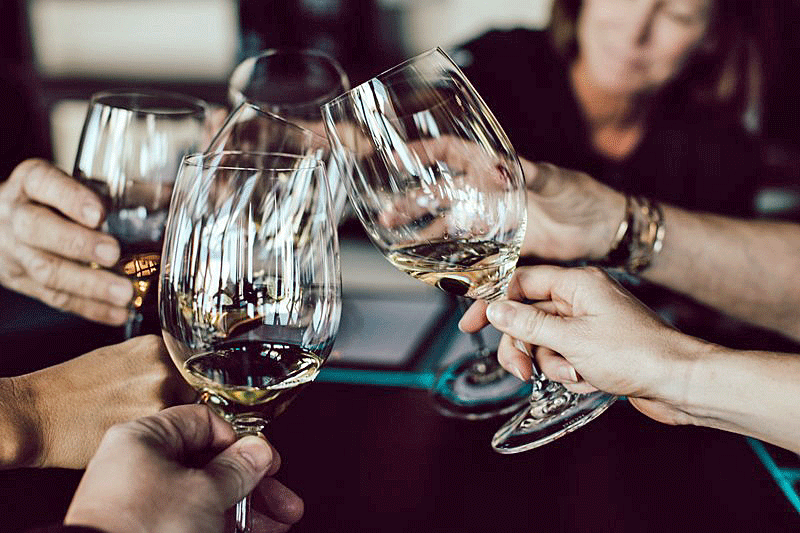
 

Wines differ from each other in color, texture, strength, body, smell, and taste. When you are tasting wine, consider these six things. Contrary to popular belief, the ability to discern flavors is not in the mouth. We smell tastes, rather than sampling them with our tongues and palates. In reality, the taste buds in our mouths can only distinguish flavors that are sour, sweet, bitter, and salty. Did you know that our flavor-sensitive nerve cells are actually at the top of the nose?


Wine Tasting in Four Steps

1. Look

 
Angle your glass over a white background and inspect the color, intensity, and hue at the rim of the glass. Wines should be transparent and bright. A wine’s color and the depth of that color, indicates its age. Wines become paler as they get older. How the liquid flows within the glass reveals a wine’s richness.

Look for cloudiness, which can reveal a fault. Sediment in red wine is normal, though it should be allowed to settle before you inspect it.


2. Smell

 
Hold the glass under your nose and inhale through your nostrils. The first overall scent is known as the “nose”. There are hundreds of aroma compounds found in wine and the best way to identify them is to detect distinctive fragrances. Swirl the glass to oxidize the liquid, taking slow, delicate inhalations. Switch between smelling and pausing, giving yourself time to pick out each aroma.


3. Taste
 
Take a good mouthful of wine and move it around your entire mouth. Once you have swallowed the wine, the aftertaste, known as the finish, should provide you with a lingering flavor profile. Great wines have a lasting flavor that remains after swallowing. If you’re at an advanced level of wine-tasting, try to identify the tannins, acidity and general structure of the wine to give a sense of overall balance.

Next, have a medium-sized sip and repeat the process. Swallow or spit out the sample. Take a slow breath through your mouth and exhale through your nose to see if you can sense any different flavors.


4. Think

 
Develop your palate by trying more wines. No one is born a wine connoisseur, so experiencing more wines helps to build your knowledge base. The more wines you try, the more you will distinguish the flavors you like. One way to actively think about the wines you are tasting is to note down your thoughts when sampling them and keep a record.

You could even rate your wines. Wine ratings were first popularized in the 1980s when Robert Parker introduced his 100 point system. Today, there are several rating scales to choose from, including a 5-star system, the 100-point scale, and a 20-point scale.


Barge Cruises with Wine-Tasting Experiences
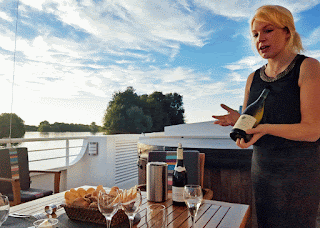
 
Why not improve your wine tasting skills by dabbling in some comparative tasting on a barge cruise? Guests can sample wines on all our cruises and experience specialty tastings in regions like Burgundy and Venice.

If you are a seasoned wine-taster, then why not bring some friends and charter a whole barge for a wine-themed cruise? There are so many cruises to choose from. Not sure where to start? Contact us.


Interested ?  Let's get started !
 
 
Inquire
 
If you have been dreaming about barging, perhaps now is the time to fulfill those dreams.
 
 
Visit our website for more info on our barges and barging: www.BargeCharters.com


#BargeCharters #BargeCruises #WineCruises #WineTasting #ParadiseConnections


Monday, April 11, 2022

Visit Burgundy’s Oldest Winemakers with French Hotel Barge Finesse

Visit Burgundy’s Oldest Winemakers
 
Maison Champy Wine Tasting Experience
 

French Hotel Barge Finesse - Burgundy Barge Cruises

Does it get any more indulgent than sampling exceptional wines at the vineyards of Burgundy’s oldest wine company? Since its founding in 1720, Maison Champy has been producing award-winning wines, and it’s the newest stop on Finesse’s itinerary.


What is so special about Maison Champy?

Maison Champy owns around twenty-one hectares of vines, with most on the Côte de Beaune. This region of France is famous for producing some of the world’s most expensive white wines and for fermenting a tiny proportion of Burgundy’s best reds.

Maison Champy makes both white and red wines, of which the most prestigious is Grand Cru. Another speciality of this experienced wine-maker is Pernand-Vergelesses premier crus, known for its intense ruby color. Planted in 1158 by the monks of the Abbey of Maizières, Le Clos de Bully in this region is one of the oldest in Burgundy. Harvesting is organic to preserve and highlight the true character of the unique terrain where the grapes are grown.


History of Maison Champy

The Champy family established themselves in the early eighteenth century and the French Revolution aided their ambitions to buy more land in Beaune. In 1779, the civil war enabled Maison Champy to expand its influence in the region and the family acquired additional land to plant more vineyards.

Maison Champy prospered again in the nineteenth century after supporting the scientific discoveries of Louis Pasteur. The forward-thinking attitude of Maison Champy meant that their wine cellars were the origin of the invention of pasteurization in the 1860s. Although the pasteurization process is now associated with the dairy industry, wine was responsible for its invention.

However, Maison Champy didn’t limit itself to just winemaking and science. At the turn of the nineteenth century, the company invested in engineering after being inspired by the unveiling of the Eiffel Tower in Paris. In 1890, a winery, fermentation cellar, and wine cellar were all built in the innovative ‘Eiffel’ style.
 

Within a decade, Maison Champy was exhibiting its wines at fairs and international exhibitions, gaining a formidable reputation as one of the best winemakers in Burgundy. Maison Champy was recognized with gold medals for two successive years in 1889 and 1900 at the Universal Exhibitions in Paris.

Today, Maison Champy is still a major player in the Côte de Beaune, exporting its prestigious wines all over the world.

 
New addition to Finesse's itinerary
 
 
The new Maison Champy wine-tasting experience, lunch and vineyard tour can be enjoyed on the Finesse classic cruise itinerary, as well as their golf and wine themed cruises. Families can also choose to visit the vineyard, where younger guests are offered a juice tasting.

The visit to Maison Champy starts after breakfast on the Wednesday of every cruise. After a drive through the UNESCO-listed Côte de Beaune vineyards, guests arrive in the capital of Burgundy’s wine country, the town of Beaune. When guests arrive at Maison Champey, Finesse’s captain will escort them through the vineyards, telling them about the surrounding landscape and the vineyard itself. On arrival at the wine house, a wine expert will take over to give a private tour of the wine cellars and a wine tasting experience. Guests will learn about the production of the region’s finest Premier and Grand Cru wines, trying two Premier Crus and three Grand Crus – one of which is from one of their best plots.

A private lunch will follow at CUVE 17. This unmissable and unique dining venue has been created from one of the winery’s historic wooden wine vats, known as “cuves”. An exceptional four-course seasonal lunch (including cheese) is served with wine pairings of Premier and Grand Crus. Guests will choose in advance from a range of dishes on a set menu which changes throughout the year.

Following the Maison Champy experience, guests visit the stunning 15th century Hôtel-Dieu Hospice and return to the barge for an afternoon cruise past the charming little town of Chagny.
 
 
Inquire

If you would like more information about a barge cruise aboard Finesse, visit our online brochure. Feel free to send an email... we are here to help :)


About The French Hotel Barge Finesse

 
Finesse is a double-decker hotel barge that has been built to exacting standards with luxury in mind, enhanced by her modern public areas and very spacious cabin suite accommodation. 

Finesse is the perfect vessel on which to cruise the meandering waterways of Southern Burgundy past vineyards and charming canalside villages, and to discover fascinating places along the way such as Autun, Beaune and Dijon.
 
Cruise Details:

Cruise Highlights:
  • Visit Clos de Vougeot, home of the Chevaliers du Tastevin
  • Tour and private wine tasting at Maison Champy, the oldest winemakers in Burgundy
  • Visit to Beaune, including Hôtel-Dieu Hospice
  • Visit to the ancient roman city of Autun
  • Lunch with wine pairings, served in a unique dining venue, created from a historic wooden wine vat
  • Excellent opportunities for walking and biking
  • "Biking Plus" option available

Learn More: 


Ready To Go Barging With Finesse?
 
Inquire


Contact Paradise Connections to book FINESSE
View Finesse's online brochure
Visit our website for more info on our barges and barging: www.BargeCharters.com

  #barginginfrance #burgundycruises #bargefinesse #bargecharters
 

Saturday, July 10, 2021

A History of Western Provence Wines

A History of Western Provence Wines
 
Want to know more about Western Provence wines? This handy little guide will reveal everything you need to know… 

 
The city of Massalia, (modern day Marseille), was founded by the Phoenicians in 6th century BC. Traders from the east plied the Mediterranean and brought vines and wine to the area, planting grapes throughout the south of France. The wines produced during this period were not "red" as we think of red wine today. Grapes were pressed and processed very quickly, giving the wines a pale color.
 
 
When the Romans took control of the region in the 2nd century, the pink wines of Massalia were already famous and coveted throughout the ancient world. Having access to the Roman Empire’s trade network only spread the wine’s popularity. The Romans created Provence without greatly changing the Italian mode. Their cities and monuments are still its grandest features. The name Provence comes from the Latin “Nostra Provincia” meaning “our province”. Provence wines on the other hand, was, until very recently, nothing special: largely overstrong and under-flavored rosé. The region was argued over by rulers of Barcelona, the Kingdom of Burgundy, the Holy Roman Empire and was dominated by the Catholic Church. Each culture contributed to the vast array of grapes now grown in Provence, but it was the Catholic monks who designed the vineyards and developed winemaking techniques which today are so important.
 
Despite its place in history, Provence is in the shadow of more prestigious areas – but things are changing! Sales of rosé, particularly in the United States, are on the upswing, growing faster than other styles of wine. Once again, "pink wine" is chic and Provence is the benchmark for rosé. Ambitious, stylish and wealthy immigrants are often drawn to Provence’s legendary countryside and climate, and many have reinvented Provence wines. An increasing proportion of its rosé wines are gently made, intriguingly perfumed and dry enough to be perfectly paired with the garlic and olive oil which characterises the region’s cuisine. The second largest, and most western, AOC in Provence, Coteaux d’Aix en Provence is heavily influenced by the famous Mistral winds, and its landscape is as soft and undramatic as the wines tend to be. The vineyards here date back as far as 600 BC and were prized by the Royal Courts of Europe in the 15th century.
 
 
Today, rosé is king and is usually a blend of Grenache, Mourvedre, Cinsault, Syrah and Counoise. Cabernet Sauvignon is grown here too. Perhaps one of the most interesting domains in Côteaux d’Aix-en-Provence is the Château Vignelaure. Acquired by Georges Brunet of Bordeaux just after the Second World War, the winery sought to pioneer Provençal blends of Syrah and the non-native Cabernet Sauvignon. In the west of the region, producers use a higher concentration of Cabernet Sauvignon, which helps distinguish their wines. The vintners around Les Baux produce some exceptionally good wines, and many of their vineyards are organic.
 
Between Aix and the River Rhône is the sub appellation Les Beaux de Provence which was created in 1995 and named after the extraordinary hilltop village of the same name. Les Baux de Provence is probably the warmest part of Provence and its home to the Val d’Enfer or the “Valley of Hell”. Vineyards lie on the hillsides of the Alpilles mountains and, although the climate and rugged terrain are inhospitable, the conditions are perfect for grapes. On average, vines need a minimum of 1,400 hours of sunshine per year to produce ripe fruit. Les Beaux averages 2,700-3,000 hours per year. The AOC regulations now permit white Les Beaux de Provence, made mainly from Clairette, Grenache Blanc and the ever-growing-in-popularity Vermentino. Warmed by the sea and buffeted by Provence’s famous Mistral, this area is even better suited to organic viticulture than the rest of Provence. The Mistral wind keeps everything dry, so rot is not a problem and the average 3,000 hours of sun doesn’t hurt either! Today, 41% of the Provence wine-makers have "gone green".
 

As might be expected of a region with a history of wine growing dating back to Roman times, Provence harbors some well-established wine zones. Perhaps the most historic is Palette on the north-facing, limestone-influenced bank of the River Arc just east of Aix, where the Rougier family of Château Simone have been making wine for over 200 years. Cassis, centered on the small port to the east of Marseille, also makes a serious effort with its distinctive, herbal-scented white wines which can be perfectly paired with the infamously local dish bouillabaisse.
 
Discover Provence
 
Inquire

We have many special offers that may be of interest


Visit our website for more info on our barges and barging: www.BargeCharters.com


Monday, March 29, 2021

Experience France: Autumn Wine Harvest

Autumn Wine Harvest
Barge Cruises in France

 
For many visitors to France, a major draw is the country’s centuries-old legacy of winemaking, particularly during the wine harvest months. Our wine appreciation cruises travelling through such renowned regions as Burgundy, Bordeaux, Champagne and Alsace, have long been popular with oenophiles keen on an inside look into the production behind some of the world’s finest vintages.

Though summer may be the peak barging season for many travellers, the vineyards of France offer up delights and surprises all year round. As the days shorten and the vine leaves turn golden, vintners begin the age-old tradition of harvesting grapes and start the winemaking process anew. If you choose to cruise in the off-peak season in Autumn, you’ll be well-rewarded with a glimpse into one of France’s most time-honored traditions.

La Vendange: The Harvest

In France, wine harvest time is known as "la vendange". Because the grapes ripen at different rates depending on species, la vendange spans about two months – typically from August to October. During this time, the French countryside is bustling with activity as vintners work to haul in the wine harvest. Though the process has been mechanised somewhat, most vineyards still harvest by hand, hiring temporary, seasonal help to deal with the enormous volume.
 
You don't need to get out into the fields and get your hands dirty to enjoy the wine harvest. In many French towns, the wine harvest season is cause for celebration and local festivals take place all across the country.

Festivals and Celebrations

Nearly every region of France produces wine, so there’s hardly a dull moment in the between August and October. One of the season’s most prestigious festivals takes place each September in Saint-Emilion in Bordeaux. Since 1199, this medieval town has held the Jurade de Saint-Emilion, during which local winemakers open their cellars to the public for two days. Similar festivals also take place in the Beaujolais region to welcome the latest Beaujolais Nouveau.

Whether big regional affairs or local celebrations, French wine festivals are an annual rite of Autumn. You can expect to see grape-pressing, taste regional foods, hear local music, and of course, drink a wide variety of local wines.

If you really need another reason to cruise in France during the Autumn, consider that the off-peak season is more relaxed than the busy summer months and value-season rates may apply. You can expect fewer crowds with summer holidays finished and children back in the classroom. What’s more, Autumn in France boasts bright, warm days and crisp nights, plus a dazzling display of yellow, orange, and red foliage across the countryside. Try Autumn cruising just once and you’ll never look back.
 
Covid-19 info:


Visit our website for more info on our barges and barging: www.BargeCharters.com


Sunday, March 28, 2021

Understanding French Wine - French barge Athos

How to Read and Understand a French Wine Label
 
The French Hotel Barge Athos who cruises along the canal du midi in southern France shares some insight on how to read and understand a French wine label...


Some tips on knowing what’s in the bottle…
 
When you’re browsing the wine shop shelves looking for the perfect trip down memory lane in a wine bottle, how can you possibly know whether anything on that shelf will resemble what you drank while you were onboard Athos?

You need to be able to understand the content on a french wine label. The best news is that fluent french is not an obligation in this case.

French wines carry considerable information on that sometimes-confusing label.  It can show where a wine comes from, how it was vinified, and which grapes were used.

Below is a great resource writtten by Total Wine & More:  a map of the Languedoc wine regions, and a diagram of what can be found and where on a typical wine label. 

It shows the areas called the AOCs – or Appellation d’Origine Controlés.  These colour-blocked areas on the map show the officially licensed french wine regions with grape-growing and vinification requirements needing to be met in order to carry the AOC mark of standard.

Following the map and label-guide below, you should be able to work out the (relative) prestige of the winery, the age of the wine, the vinification, the grape varietals.   Voilà.  How to understand a french wine label.

How to Understand a Languedoc Wine Label
 
(with explanations in red)

(Click image to enlarge)

(Click image to enlarge)
 
Thanks for the information, Athos!

About The French Hotel Barge Athos

Hotel Barge Athos on the River Orb aqueduct

Athos

Cruise Highlights:
  • Tour of the medieval city of Carcassonne
  • Private tour and tasting at a Minervois winery
  • Organic Olive Tasting at L’Oulibo
  • Cruise through the natural haven that is the “Petit Camargue”
  • Tour and tasting at the Noilly Prat vermouth distillery
  • Excellent towpath for walking and cycling

Covid-19 info:


Contact Paradise Connections Yacht Charters to book ATHOS
View Athos' online brochure
Visit our website for more info on our barges and barging: www.BargeCharters.com


Thursday, November 19, 2020

Happy Beaujolais Nouveau Day

It's Beaujolais Nouveau Day
Beaujolais Nouveau Day is celebrated in the French region of Beaujolais (30 kilometres northeast of Lyon) on the third Thursday in November to mark the first release of Beaujolais Nouveau wine, just weeks after the wine’s grapes have been harvested. Exactly one minute after midnight strikes on Beaujolais Nouveau Day, the wine is released to the world.

It's not just the wine that is celebrated, it is also a chance to honor the stunning region of Beaujolais and its people. It is on this date that the region comes alive with fireworks, music and festivals. In fact, there are over 100 festivals held in the region in honor of the event, the most famous of which is in Les Sarmentelles de Beaujeu, the capital of the region.

How is Beaujolais Nouveau Made?

This fresh and fruity wine is made from Gamay grapes and must be harvested by hand. They are then kept in a huge sealed vessel filled with carbon dioxide. As the grapes at the bottom are crushed and start to ferment they give off more CO2, which aids the fermentation of the uncrushed grapes, too. This is a process called "carbonic maceration" and is the key to the short fermentation process with a fresh and low-tannin flavor.

Originally, Beaujolais Nouveau was consumed only by locals as a budget-friendly primeur (young wine) to toast the end of the harvest. Unlike other wines, standard vintages have a short shelf life of around six months.

The Race to Market

It is perhaps this short lifecycle that has encouraged the worldwide race to bring the wine to market in November each year. The slogan “Le Beaujolais nouveau est arrivé” has adorned banners and posts all over the world to advertise the arrival of the wine, although the new slogan “It’s Beaujolais Nouveau Time” was introduced in English-speaking countries in 2005.

Mark the Occasion in Style

This fresh, young wine is the perfect choice for serving slightly chilled, and paired with a selection of good French cheeses and charcuterie. Often described as a party wine, it’s the perfect excuse for marking the occasion with friends.

Le Beaujolais nouveau est arrive!

A cruise aboard a Hotel Barge in France is an excellent way to experience wine and culture. You may even choose a wine-themed cruise.


Visit our website for more information on our barges and barging: www.BargeCharters.com


Saturday, July 25, 2020

Wine & Cheese

Wine and Cheese
A Very French Pairing

On a hotel barge cruise, one of the wonderful ways you can experience the best of your cruising region is through the cuisine. Barge chefs and sommeliers are aficionados of the local produce and as such, they will pair some of the finest French wine and cheese. Prepare yourself for the flavors of a lifetime!


There are a number of similarities between French wine and cheese. Both go through a fermentation and ageing process; both have flavors that vary depending on the soil, sunlight, rainfall and geography of the area in which they are produced. In France, both are given the esteemed certification of AOC (Appellation d’Origine Contrôlée) to indicate the quality and provenance of their traditional production.

Like wine, the tasting of cheese is something of a science, as different regions produce so many diverse flavors in all shapes, sizes and colors. If you are a cheese connoisseur, you will certainly be able to indulge your passion on any of our hotel barge cruises in France, where each barge takes pride on procuring and serving the best each region has to offer.

 A Cheese to Please All Palates

Cheeses can be classified in a number of different ways. For example, by the country or region of origin: a hard cheese made in the Alpine climes of Beaufort would be incredibly difficult to make in the flat, western region of Normandy.

Another difference is the method of production: for example, the outside of washed rind cheeses are repeatedly dusted with ‘morge’ – a mixture of brine, whey and old cheese scrapings – to create a colored rind, while the inside of a blue cheese is pricked with needles to grow blue mould.


A Bit About Cheese

Some specialized vocabulary is helpful in the understanding of cheeses. One who has become a turophile, or lover of cheese, will no doubt be conversant with the following terms.

Specialty Cheeses – It might be said that every French cheese is a specialty cheese, but some are more special than others. Artisanal cheeses are those which have been crafted by hand from the finest ingredients, cheeses made on a farm, chalet, or mountain hut are called fermier, a monastery-type cheese is a term that describes cheeses which once were or continue to be made in the monasteries of France.

The Parts of a Cheese – The pâte of a cheese is all that is within the rind or the crust of the cheese. The rind is the part of the cheese formed in the natural, external thickening of the surface, not all rinds are edible. A cheese has a natural rind when it has formed as a result of the drying of the outer surface during ageing. Some cheeses have eyes, which are holes or voids in a cheese produced by gas which has been unable to escape during the curing process.

These varying processes and environments create cheeses that are wildly different in texture, smell and taste, which we invite you to try as part of every meal during your culinary voyage of discovery.

So open your eyes to a world of delicious, French wine and cheese on any of our French hotel barge cruises – you won’t be disappointed!


Visit our website for more info on our barges and barging: www.BargeCharters.com


Tuesday, November 26, 2019

It's National Cake Day

Madeleines
A Traditional Teatime Treat


Celebrate National Cake Day with this recipe for spongey, golden Madeleines – a traditionally French afternoon treat that’s impossible to resist!

I love Madeleines - even the store-bought ones!

Did you know, Madeleine or petit Madeleine cakes originate from the Lorraine region in northeastern France? Traditionally shell-shaped, these buttery and spongey cakes enjoy a delightfully crispy batter.

The name "Madeleine" according to some, was given to the cakes around 1755 by French King Louis XV to honor Madeleine Paulmier, his father-in-law's cook.

Try making them today with this easy to make recipe.

Ingredients

Makes 12 cakes
  • 2 large eggs
  • 130g sugar
  • 1 tsp vanilla extract
  • 1/2 teaspoon lemon zest (I like orange as well)
  • Pinch of salt
  • 120g flour
  • 300g unsalted melted butter
  • A sprinkling caster/powdered sugar

Ingredients

  • Preheat oven to 180°C or 350°F. Line your Madeleine molds with butter and dust with flour.
  • Using an electric whisk, beat your eggs and eggs sugar in a mixing bowl.
  • Mix in your vanilla extract, lemon zest and salt, before adding the flour until a batter is formed. Slowly add the melted butter.
  • Spoon a tablespoon of your batter into each of the Madeleine molds and bake for about 15 minutes, or until the batter appears golden brown.
  • Cool before removing from the molds.
  • For the next batch, repeat the process – buttering and flouring the molds each time you use them.
  • Dust lightly with caster sugar before serving.

You can find madeleine pans on Amazon.

Speaking of Lorraine . . .

French Hotel Barge Panache

The 12-passenger Hotel Barge Panache cruises in Holland & Belgium during the springtime, then through Paris to Champagne, and finishes their season in the Alsace-Lorraine region of France.


Panache

The 128-foot Panache is a 12-passenger luxury hotel barge of classic Dutch design, fully air conditioned with spacious public areas and six en-suite stateroms, with your choice of twin or double bed configuration. En-suite bathrooms have twin sinks and oversize showers with massage jets. Panache is traditionally furnished in an old ship style with brass and mahogany, creating a comfortable and charming ambience. The salon and dining room have large panoramic windows for viewing the passing countryside, as well as comfortable sofas, books and music, and an always open inclusive bar. The sun deck is spacious and has a heated spa pool; a perfect place to watch the sun set after dinner.

Panache has a highly professional crew of six, comprised of Master Chef, Deck Hand, Tour guide, two Housekeepers, and led by a knowledgeable and experienced Captain, who will ensure your cruise is memorable and more.


Contact Paradise Connections Yacht Charters to book PANACHE
View Panache's online brochure
Visit our website for more info on our barges and barging: www.BargeCharters.com