Showing posts with label Barge Renaissance. Show all posts

Tuesday, April 05, 2022

The Canal de Briare - Part 3

 
 Part 3: Places of Interest

on the Briare Canal

The picturesque Canal de Briare, one of the oldest canals in France, connects the valleys of the Seine and the Loire. The Canal de Briare begins just north of Montargis at Buges. The section of the canal between Montargis and Rogny follows the valley of the River Loing. Many of the villages and hamlets date earlier than the origin of the canal. 
 
 
The Château de Saint-Fargeau is a 17th-century, Renaissance château, originally built as a hunting residence in the 10th century. Destroyed in the 15th century, a castle replaced it. This castle was itself destroyed by fire but promptly rebuilt in the 17th century, with additions and major improvements made in the 19th and 20th centuries.
 
The Château de Saint-Fargeau has a distinctive design. From above, the château’s curtained walls and towers form an irregular pentagon, the corners of which are formed by six towers of pink brick. Lanterns top five of the towers. Designated as a historic monument in 1945, the château has been open to the public ever since. The château has organized a sound and light show each year to raise funds for additional restorations. The spectacle lasts two hours and spans ten centuries of history, from the end of the 10th century through the Liberation in 1944 by the American army. This production has taken place for more than 35 years and involves over 700 actors and 50 horse riders from the surrounding community.
 
 
The Château of Sully-sur-Loire was first built as a defensive fort to protect one of the few places to ford the Loire. Today it is one of the most impressive and picturesque châteaux in the region. 

 
With its origins in the 11th century, the Château de Ratilly was built on existing foundations in the 13th century. Today, Ratilly is a creative Center for the Arts and a pottery workshop, continuing a local tradition which has existed since the Roman occupation of France. The château transformed into a fine residence during the Renaissance when many of its defenses were no longer needed. Arrow slits changed into large windows and some towers were modified for other purposes. Visit the magnificent Château de Ratilly on your cruise with the barge Renaissance on the Canal de Briare.


What may seem like a rather small and uninteresting little church is, in fact, one of the most important in Burgundy. The church of Saint Peter and Saint Paul in the village of Moutiers-en-Puisaye started life as a priory, built by monks in the 10th century in the Romanesque style. An 8th century hospice on the site took care of pilgrims, especially those from Brittany and England, who were traveling to Rome to visit the tomb of Saint Peter. The derivation of Moutiers is from the French word for monk, moine.
 
During the Hundred Years War, a band of marauding Bretons traveling south destroyed the priory and the hospice but left the church standing. In the 19th century, it was one of many studied by the French architect Eugène Viollet-Le-Duc and, in 1862, became classified as a historic monument. What Viollet-le-Duc didn’t know, however, was that under the whitewashed plaster walls, the church was hiding an incredible secret.
 
In the spring of 1982, after an especially dry warm spell, cracks appeared in the plaster and parts crumbled and fell off, revealing color and images. Over 10 years, an expert restorer of medieval iconography, Isao Takahashi, worked, in part, in the restoration of the 12th century murals and frescoes.
 
The 200m² of painted murals are some of the most important in Burgundy today. They describe in great detail scenes from the Bible, including Genesis, the Great Flood, Adam and Eve, Cain and Abel, as well as the life of Christ from the Nativity, the Baptism in the river Jordan, and His subsequent crucifixion.
 
 
La Bussière takes its name from the wood it once grew, with Buxeria being Latin for a plantation of trees. The village lies on the edge of the old Roman road, the Via Agrippa. Several Roman artefacts were found in its locale. The château was built in the 12th century by the local Lord, Stephen de Feins. Well situated on the road running from the Loire Valley and Paris, the village soon became a postal stop and a commercial hub, with much of its income going to the estate of the château.
 
During the French Wars of Religion of the 16th century, La Bussière was a Catholic stronghold, whereas the neighboring town of Gien was largely Protestant. In 1567, a group of Huguenots attacked the village and killed 17 Catholic priests, damaging the château in the process. Rebuilt in the 17th century, the château was enclosed by the pond and gardens, designed by Louis XIV’s chief gardener André Le Nôtre. After the French Revolution, the castle changed hands several times until eventually sold to the current owners, who have lived on and maintained the property for over 200 years.
 

 Lavishly decorated by the finest craftsmen and architects in Europe, the Château de Fontainebleau was truly the greatest residence of the Kings of France. Francis I brought the Italianate style, known as the Renaissance, to France while overseeing the construction of the palace, whereas Henri IV created magnificent gardens in and around the forest which surround it. Every monarch from Louis VII to Napoleon III has put their mark on the palace and today it radiates with the Kings’ ideals of wealth, luxury and elegance.
 

 Moret-sur-Loing is a fortified town on the banks of the River Loing. Once part of the Royal Domaine, it found its fame while the Impressionist painter Alfred Sisley lived within its ancient walls in the 19th century. Sisley painted many rural and industrial scenes around Moret-sur-Loing and today is recognized as one of the most important English Impressionist artists.
 

Once the capital of the Province of Berry, the city of Bourges has an intriguing architectural history. While the Cathedral, considered as one of the earliest examples of the high Gothic style in the 13th century, the palace built for Jacques Coeur, is still one of the finest examples of medieval architecture in France. The city has remained well preserved, with many half-timbered buildings and fine townhouses. 


Orléans on the River Loire, is most famous for being the home of Joan of Arc and as the site of the Siege of Orléans which began the end of the Hundred Years’ War. Today it is a shining example of French medieval architecture and the 13th century cathedral is one of the most beautiful in France.
 

Perched high on a hill overlooking its famous, eponymous, wine-growing region, Sancerre was first founded by the Romans. Its name is thought to come from the phrase “San Caesar”, meaning Caesar’s Temple. During the Religious Wars of the 16th century, Sancerre was a Protestant stronghold and fought off many Catholic attempts to besiege it. During the French Revolution, the town was a Royalist stronghold. Sancerre was the local command center for the French Resistance throughout the Second World War and, although the Germans occupied the area, the resistance still continued their work.
 

Built in the 19th century by Compte Lafond in a variety of architectural styles, including Renaissance, Bavarian and Gothic, the Château du Nozet is one of the most romantic châteaux of the Loire. It has been the seat of the Ladoucette family for over 200 years and over 160 hectares of some of the most prestigious vineyards in the Loire surround it.
 
 
Situated on the ancient pilgrimage route to Saint James of Compostella in western Spain, La Charité-sur-Loire is a beautifully preserved medieval town and today a UNESCO World Heritage Site.
 

About The French Hotel Barge Renaissance


Renaissance has been designed to carry her guests in ultimate luxury along the Canal de Briare, France’s oldest canal and steeped in history on a cruise route that features elegant chateaux, small countryside villages, and the famed wine-growing region of Sancerre.


Cruise Details:


Cruise Highlights:
  • Visit the “time capsule” studio home of 19th century artist Rosa Bonheur and a private lunch in her salon
  • Private “behind-the-scenes” tour of the magnificent Château de Fontainebleau
  • 7-lock flight at Rogny-Les-Sept-Ecluses, a national historic monument
  • Cruise across the aqueduct at Briare, built by Gustave Eiffel over the River Loire
  • Private wine tasting at the renowned Sancerre winery of Henri Bourgeois
  • Excellent opportunities for walking and biking
  • "Biking Plus" option available

Learn More: 


Ready to Explore the Canal de Briare?


Contact Paradise Connections Yacht Charters to book RENAISSANCE
View Renaissance's online brochure
Visit our website for more info on our barges and barging: www.BargeCharters.com

  #barginginfrance #loire-burgundycruises #bargerenaissance #bargecharters


Monday, April 04, 2022

The Canal de Briare - Part 2

 Part 2: Towns & Villages

Along the Briare Canal

The picturesque Canal de Briare, one of the oldest canals in France, connects the valleys of the Seine and the Loire. The Canal de Briare begins just north of Montargis at Buges. The section of the canal between Montargis and Rogny follows the valley of the River Loing. Many of the villages and hamlets date earlier than the origin of the canal.
 
 
Montargis is one of the “villes fleuries”, a designation awarded to towns and villages with fabulous floral displays. Also known as the “Little Venice of France”, many small canals dissect this lively and attractive town. The Canal de Briare wends its way right through the center of Montargis, with its banks behind the 17th century houses. The town’s museums provide a wealth of information on local arts and traditions. During the reign of Louis XIII, a local chef invented a confection made from roasted almonds covered with sugar, which became known as pralines.

The origins of Montcresson are uncertain, though two relics of an ancient settlement, a pierced stone and a tumulus (a burial mound), were found in the vicinity. Within the town itself, there are several 13th century buildings, including the church, castle, and a former convent.
 
During the construction of the canal in Montbouy, engineers uncovered the remains of a 2nd century Gallo-Roman bathhouse and an amphitheater which had a capacity of 4000. The 11th century church has seen many alterations since its construction, the last being in the 17th century. The church was added to the list of Historic Monuments in 1967. Originally, there were two locks separated by a little lake, which were replaced by one lock in 1892. Today, we can still see one of the old locks without its gates.
 
Châtillon-Coligny, once known as the town of Châtillon, entered the ownership of the Coligny family in 1437. Because the four Coligny sons were Protestant, the town suffered during the Wars of Religion, which began with overt hostilities in 1562 and lasted until the Edict of Nantes in 1598. Admiral de Coligny, the chief of the Huguenots, was murdered in Paris as part of targeted assassinations and a wave of Catholic mob violence directed against Protestants by order of the Queen, Catherine de’ Medici, during the Religious Wars, in what was later called the St-Bartholomew’s Day Massacre. “Une foi, une loi, un Roi” (one faith, one law, one King) left little room for religious tolerance.
 
Musée de Châtillon-Coligny
 
Châtillon-Coligny retains some of the medieval town atmosphere, including the original wash houses where inhabitants scrubbed their washing in the river. A superb 12th century château, built by the Count of Sancerre, was destroyed in 1799 during the French Revolution. All that remains are three monumental terraces, the orangerie, and an impressive sixteen-sided dungeon. 

In modern history, the settlement received some fame in 1903 when Henri Becquerel won the Nobel Prize for Physics for the discovery of natural radioactivity.
 
Rogny-les-Sept-Écluses is at the bief de partage, or watershed, of the Canal de Briare. Here the canal leaves the valley of the Loing, climbs towards its highest point, crosses a small marshy plain, and begins the descent to the Loire. Fifteen reservoirs were dug near Rogny to provide water for this section.
 
In order to extend the Canal de Briare out of the Loing Valley, it was necessary to build a linked series of locks. In 1642, the famous seven lock staircase opened and worked without interruption for two centuries. On average, the locks passed around 4,000 boats and 200,000 tons of cargo per year.
 
 
In 1880, they replaced the seven locks with the current six Freycinet gauge locks. Separated about 500 meters from each other, the new locks bypass the hill. They abandoned the old locks in 1887, as they were too small and consumed too much water. The seven locks became a historic monument in 1983. Rogny changed its name to Rogny-les-Sept-Écluses in 1978 to honor its famous monument.

Briare is one of the largest towns in the Loiret and is the town from which the Canal de Briare takes its name. The town was founded in the 17th century, relatively modern by French standards, with the building of the canal. Opposite the commercial port, a series of buildings and chimneys are all that remain of the tile and button factory that once occupied the site. The Émaux de Briare, founded in 1837 by the 19th century French business magnate Jean-Félix Bapterosses, exhibited its wares at the 1851Great Exhibition in London. Still in operation, though not from Briare, the company sells its mosaics around the world for large and small projects alike.
 
Jean-Félix Bapterosses built a château to the north of Briare. Today it serves as an exhibition center and an artists’ residence. In the center of the town is the interesting 19th century Romanesque-Byzantine church dedicated to Saint Stephen. This church is particularly remarkable due to its beautiful decorations both inside and outside the building, which were provided by the Émaux de Briare. It was added to the list of historic monuments in 1987.
 
Probably the most famous monument in Briare is the aqueduct, built to allow commercial boat traffic to cross the River Loire in the 1890s. Until that point, barges had to traverse the Loire River itself. This was always an issue. In the summer months, the river was too low, and during the winter, there was too much water. The Loire is one of the last “wild” rivers left in Europe, and there is almost no commercial traffic using the river. It is very hard to chart the Loire as sandbanks are constantly shifting with the current and change position every year. The only boats that frequently navigate the river are the traditional, flat-bottomed boats called gabards.
 

The French engineer Léonce-Abel Mazoyer is credited with the design of the bridge, while the architect Gustave Eiffel oversaw the design of the masonry and abutments which the iron work sits on. The bridge is 600 metres long and holds 13,000 tonnes of water.

Besides being functional, the Pont Canal de Briare is recognized as one of the most spectacular works of art on the French waterways.
 
Châtillon-sur-Loire was first mentioned as a 10th century fortification. In the 16th century, Châtillon was a Huguenot stronghold during the French Wars of Religion and a Protestant “temple” in the center of the village was built in 1596. By the 17th century, it was the most important Protestant community outside Gien. To control the movement in the village, Louis XIV sent a group of Catholic priests to oversee religious teachings and to reduce the influence the group was having over neighboring communities. By 1684, Châtillon outlawed Protestantism, and the temple was destroyed on orders by the King. In the 19th century, they imprisoned the Scottish author Robert Louis Stevenson in Châtillon for several days for being homeless. It is said he fell in love with a local girl and refused to leave her until she married him. She wouldn’t and he eventually left for California, whereupon he found the girl of his dreams.
 

About The French Hotel Barge Renaissance


Renaissance has been designed to carry her guests in ultimate luxury along the Canal de Briare, France’s oldest canal and steeped in history on a cruise route that features elegant chateaux, small countryside villages, and the famed wine-growing region of Sancerre.


Cruise Details:


Cruise Highlights:
  • Visit the “time capsule” studio home of 19th century artist Rosa Bonheur and a private lunch in her salon
  • Private “behind-the-scenes” tour of the magnificent Château de Fontainebleau
  • 7-lock flight at Rogny-Les-Sept-Ecluses, a national historic monument
  • Cruise across the aqueduct at Briare, built by Gustave Eiffel over the River Loire
  • Private wine tasting at the renowned Sancerre winery of Henri Bourgeois
  • Excellent opportunities for walking and biking
  • "Biking Plus" option available

Learn More: 


Ready to Explore the Canal de Briare?


Contact Paradise Connections Yacht Charters to book RENAISSANCE
View Renaissance's online brochure
Visit our website for more info on our barges and barging: www.BargeCharters.com

  #barginginfrance #loire-burgundycruises #bargerenaissance #bargecharters


Sunday, April 03, 2022

The Canal de Briare - Part 1

Part 1: About the Canal de Briare
 
French Hotel Barge Renaissance traversing the aqueduct
 
The picturesque Canal de Briare, one of the oldest canals in France, connects the valleys of the Seine and the Loire. A popular route for both private and commercial cruising vessels, the canal is renowned as one of the loveliest places for a barge cruise, and being a highly impressive feat of engineering.
 
(click map to enlarge in a new window)

The Canal de Briare begins just north of Montargis at Buges. The section of the canal between Montargis and Rogny follows the valley of the River Loing. Many of the villages and hamlets date earlier than the origin of the canal.
 
 
History of the canal - An engineering triumph
 
The Canal de Briare, the first summit-level canal in Europe (35 miles & 35 locks), joins the Loire to the Seine via the Loing River. On the Seine side, 24 locks make up for a difference in height of 252 feet, and on the Loire side, 12 locks make up for a difference of 135 feet.
 
 
The Canal de Briare was first considered by Maximilien de Béthune, King Henry IV’s first minister and the Duke of Sully, as a way of getting produce from the Loire Valley and Gâtinais to Paris quickly and efficiently. In the 17th century, Paris was booming and its population was hungry. A canal linking the food bowl of France with the growing metropolis would cut the food shortages Paris was experiencing. It would also provide the local area with employment and the King with taxes.
 
Satisfied with the plans, Henry IV awarded the project to the engineer Hugues Cosnier in 1604. Work started on the building of the canal and 12,000 workers toiled to dig the canal by hand.
 
The Canal de Briare was the first canal to be constructed at summit level using pound locks, which feature a chamber with gates at either end to control the height of the water within. Before then, locks only had a single gate. A summit-level canal first rises and then falls along its course. The 57km Canal de Briare rises through 12 locks, then falls 85 meters with its 24 descending locks.
 
 
During construction, they created several artificial lakes to feed water into the locks. At the most precipitous location, Rogny, it was necessary to build a “staircase” of seven locks in order to navigate the fall of the canal. While it was an outstanding feat of engineering, the design caused huge hold-ups, as each vessel had to navigate all seven locks before the next could pass through. In the end, they abandoned the staircase of locks and re-routed the canal to bypass them. Later, they renamed the town Rogny-les-Sept-Ecluses in its honor.
 
The assassination of King Henry IV in 1610 halted construction for 10 years. Cosnier was invited to continue the ambitious project in 1620. Guillaume Boutheroue took charge in 1629 after Cosnier died. They completed the canal in 1648.
 
Unlike the Canal du Loing, which follows a river its entire length, the Canal de Briare is a watershed canal. The canal suffered from water shortages when it first opened, even though supplied by carefully designed reservoirs. In the late 19th century, they diverted the canal over the River Loire with the construction of the Briare Aqueduct.
 

About The French Hotel Barge Renaissance


Renaissance has been designed to carry her guests in ultimate luxury along the Canal de Briare, France’s oldest canal and steeped in history on a cruise route that features elegant chateaux, small countryside villages, and the famed wine-growing region of Sancerre.


Cruise Details:


Cruise Highlights:
  • Visit the “time capsule” studio home of 19th century artist Rosa Bonheur and a private lunch in her salon
  • Private “behind-the-scenes” tour of the magnificent Château de Fontainebleau
  • 7-lock flight at Rogny-Les-Sept-Ecluses, a national historic monument
  • Cruise across the aqueduct at Briare, built by Gustave Eiffel over the River Loire
  • Private wine tasting at the renowned Sancerre winery of Henri Bourgeois
  • Excellent opportunities for walking and biking
  • "Biking Plus" option available

Learn More: 


Ready to Explore the Canal de Briare?


Contact Paradise Connections Yacht Charters to book RENAISSANCE
View Renaissance's online brochure
Visit our website for more info on our barges and barging: www.BargeCharters.com

  #barginginfrance #loire-burgundycruises #bargerenaissance #bargecharters


Monday, March 28, 2022

French Barge Renaissance: Visit Artist Rosa Bonheur's Home

French Hotel Barge Renaissance Adds Visit to Rosa Bonheur's Home


 French Hotel Barge Renaissance - Canal de Briare & Canal Latéral à la Loire


The French hotel barge Renaissance has added a visit to the home of Rosa Bonheur to their itinerary. She is the most celebrated female artist of the 19th Century. On this truly fascinating tour, guests will discover her studio that remains completely untouched since her death in 1899.
 
 
Who was Rosa Bonheur? 
 
Rosa Bonheur was successful from a very young age. Born in 1822 in Bordeaux, her father, also a painter, encouraged her talent and artistry. She exhibited at the Paris Salon for the first time at the age of 19, and received medals for her work. Bonheur’s love for animals, especially horses, is apparent through her artwork.
 
 
Her most famous painting, The Horse Fair (Le marché aux chevaux), depicting a Parisian horse fair, was submitted to the 1853 Salon and quickly raised Bonheur to international fame. The original artwork is housed at The Metropolitan Museum of Art in New York.

She lived an unconventional lifestyle for her time. Bonheur enjoyed a cropped haircut, she smoked, and she shared her home with lifelong companion, Nathalie Micas. Trousers and blouses were a common feature of her appearance. In fact, Bonheur asked permission from local authorities to wear trousers when researching for ‘The Horse Fair,’ so that they would not disturb her in such a masculine environment.

Rosa Bonheur became the first female artist to be awarded the Legion of Honour in 1865. Thirty years later, she was the first ever woman to become an Officer of the Legion of Honour.
 
 
An American Connection: Painting Buffalo Bill 
 
Bonheur developed a fascination with the American West. Being a forward-thinking woman she identified America with the liberation of women and a progressive attitude that conformed to the principles bestowed upon her by both of her parents in her youth. When Col. William F. Cody travelled to Paris for the Universal Exposition in 1889 with his world-famous Buffalo Bill's Wild West Show, it became a high point in her life which she spoke about frequently until her death.
 
 
During this time, it was not Claude Monet, Henri Toulouse-Lautrec, or Vincent Van Gogh that was regarded as the most famous painter living in Europe, it was, in fact, Rosa Bonheur. Her visits to Buffalo Bill's Wild West Show encouraged a new enthusiasm for including images of people once again. On our tour, we view sketches and paintings of Native Americans, buffalo, and mustangs. In a glass-doored armoire next to her studio, you'll find an authentic costume of Rocky Bear, a chief of the Oglala Sioux tribe, which was given to her by Buffalo Bill.
 
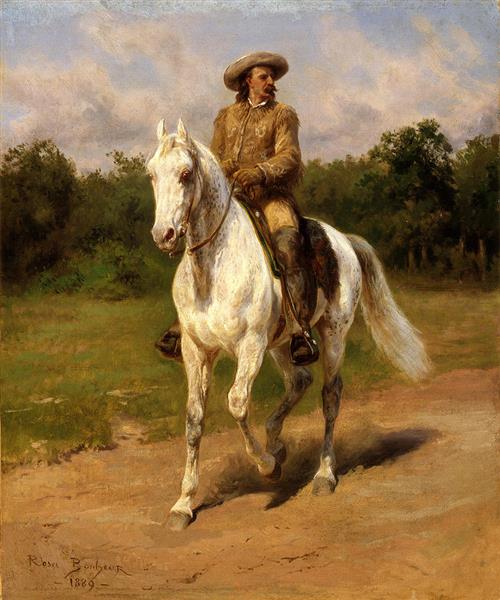
Rosa Bonheur invited Cody to her home to create one of her masterpieces, a portrait of Buffalo Bill on his horse, Tucker. The portrait was gifted to him as a thank you for allowing Bonheur to continue painting at his Wild West shows. It was such a beloved gift, that when his home in North Platte caught fire, he telegrammed his wife, Louisa, to "Save Rosa Bonheur's picture, and the house may go up in blazes." This famous portrait is also part of the display.
 
 
Exploring the Home of Rosa Bonheur 


Since her death on the May 25, 1899, time appears to have stood still in the studio within the home of Rosa Bonheur. Visitors will get not only witness her painting style with both complete and unfinished works, but they will also have the opportunity to witness her unusual fashion choices for women of her time. Her embroidered blouse, her hat, and her boots share a space with her sketchbooks and notes – even her cigarette butts! These archives offer a raw, uninterrupted outlook on her life in an unprecedented way.


About The French Hotel Barge Renaissance


Renaissance has been designed to carry her guests in ultimate luxury along the Canal de Briare, France’s oldest canal and steeped in history on a cruise route that features elegant chateaux, small countryside villages, and the famed wine-growing region of Sancerre.


Cruise Details:


Cruise Highlights:
  • Visit the “time capsule” studio home of 19th century artist Rosa Bonheur and a private lunch in her salon
  • Private “behind-the-scenes” tour of the magnificent Château de Fontainebleau
  • 7-lock flight at Rogny-Les-Sept-Ecluses, a national historic monument
  • Cruise across the aqueduct at Briare, built by Gustave Eiffel over the River Loire
  • Private wine tasting at the renowned Sancerre winery of Henri Bourgeois
  • Excellent opportunities for walking and biking
  • "Biking Plus" option available

Learn More: 


Ready to Explore the Home of Rosa Bonheur?


Contact Paradise Connections Yacht Charters to book RENAISSANCE
View Renaissance's online brochure
Visit our website for more info on our barges and barging: www.BargeCharters.com

  #barginginfrance #loire-burgundycruises #bargerenaissance #bargecharters